Public Vitality Camp
A civic infrastructure for resilience questions that need shared action
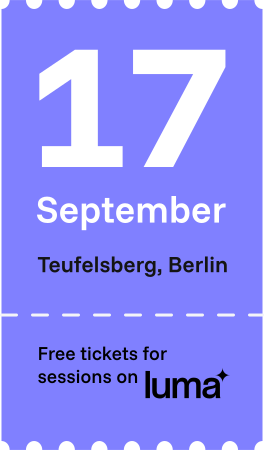
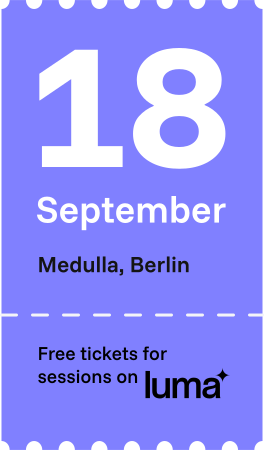
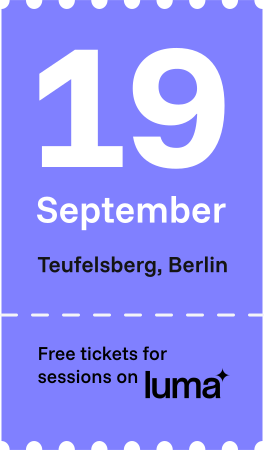
September 17-19, 2026 / Teufelsberg, Berlin
Australia 2027, Naarm / Melbourne Campsite TBC
European Summer 2027, Montserrat, Catalonia

Many of the pressures shaping public life are already well discussed and partially understood. What remains difficult is turning that awareness into shared capacity.
Yet, responsibilities are scattered, good practices stay local, and tensions are often acknowledged in private and softened in public.
At Teufelsberg, we work on tensions felt in Berlin but connected to wider systems: energy, AI and water use; housing and climate adaptation; peace, security and social cohesion.
Here, resilience means more than absorbing the next shock. It involves protecting what matters, anticipating change, working through conflict and strengthening the foundations public life depends on.
The Public Vitality Camp creates a working environment for resilience questions that cut across institutions, communities and sectors.
Outcomes include a prototype, an agreement, a stronger practice, a new alliance, a clearer conflict or a decision ready to move forward.
Why Public Vitality?
We keep seeing a pattern in public-sector and civic work: awareness grows faster than the capacity to act while the solutions for today’s challenges might look outdated tomorrow.
Institutions recognise problems but lack time, mandate or relationships. Communities hold practical knowledge but remain far from decisions. Pilots end. Lessons from crises fade.
Public Vitality names the capacity of people, institutions and communities to remain capable under changing conditions – and to develop what those conditions now require.
Public life does not emerge automatically. People may share the same concern without a common language, relationship or route into action. The public has to be constantly maintained and cared for.
Vitality asks what a system is able to generate and renew: initiative, trust, judgment, responsibility and the capacity to learn.
A service may keep running while exhausting the people who sustain it. A neighbourhood may appear resilient because residents absorb costs once carried by public infrastructure. Both can look efficient in the short term while weakening future capacity.
We explore what adaptation makes possible over time: stronger relationships, better decisions, greater capacity to act – and fewer costs passed on to the next crisis.
Why Camp?
A camp is provisional. It concentrates attention. People arrive with different equipment, knowledge and reasons for being there. They have to orient themselves together.
It can be a base for exploration, a place of preparation, a site of protection or repair. It may also carry less comfortable associations: command, defence, surveillance, exclusion. At Teufelsberg, those meanings are present in the landscape itself.
The site was built from the ruins of war, later used for military intelligence, then abandoned, appropriated, contested and partly reclaimed by cultural and ecological life. It is not a neutral venue, inviting questions that would sound abstract elsewhere:
- What needs to be protected?
- What are we still defending out of habit?
- Which tensions can no longer be avoided?
- What needs to be repaired, tested or built differently?
- Which capacities can only be developed together?


Teufelsberg 2026
From 17 to 19 September 2026, Teufelsberg will become a temporary working site for people and organisations dealing with questions that cut across responsibilities, sectors and time horizons.
Working on what Berlin needs to carry forward together.
The final agenda will not be decided entirely in advance. It will grow from an open call, targeted conversations, research and a collective portfolio session.
Open Call: https://nextlearning-earth.notion.site
Some starting points are already visible.
A city under pressure
The January power outage in Berlin made one thing hard to ignore: energy, communication, care, mobility, administration and neighbourhood support do not fail separately. The formal response may sit with one institution; the consequences do not.
How do cities prepare for cascading disruption without turning every public question into a security exercise?
Housing, heat and health
Protection from extreme heat is shaped by dense neighbourhoods, overheated buildings, and unequal access to green space. Tenants often have little influence over structural adaptations, while energy costs and health risks fall unevenly across the city.
Who can act quickly, who pays, and which measures risk solving one problem while deepening another?
Democracy, peace and security
Polarisation is often discussed as a problem of public discourse. It also grows through housing pressure, administrative exclusion, fear, inequality, ecological loss and the feeling that important decisions happen elsewhere.
What capacities help institutions and communities stay in relationship when agreement is unlikely?
Public decisions under uncertainty
Public institutions are increasingly asked to make decisions whose consequences travel across systems and unfold over years. More data does not remove uncertainty. Models can clarify some assumptions and hide others.
How can decisions remain responsible when no actor holds the whole picture?
Land, nature and public value
Land is often treated as a development asset or maintenance cost. Yet living systems provide essential public value: cooling, water retention, biodiversity, health and regenerative economic potential.
How can cities restore, finance and maintain these capacities over time? Who carries responsibility across sectors and generations?
Hidden foundations of public life
Some infrastructures are highly visible: power grids, transport systems and hospitals. Others are easier to overlook – care relationships, maintenance, meeting places, local knowledge, informal coordination and trust.
How can cities recognise and support these foundations before they become visible through failure?
Beyond the pilot
Berlin has no shortage of promising pilots. The harder question is what happens afterwards. Which practices deserve to become durable? What kind of institutional, financial or civic support would that require? And when is scaling the wrong ambition?
The Process
Sensing
Forging transdisciplinary alliances
Camping
Laboratory for public vitality & cultural diplomacy
Embedding
From Impulses to structures and maintenance
100 days before
- Administration meets civil society
- Science meets neighborhood
- Security meets culture
- Business meets activism
3 days on site at Teufelsberg
- Storytelling formats & rituals
- Workshops & ideathons
- Walks & Discourses
- Prototyping & alliances
100 days after
- Clarify responsibilities
- Consolidate micro-infrastructures
- Integration into district
- Documentation for bioregions & beyond
Working with tension
Many public challenges are called coordination problems. Often, they are conflicts.
Mandates clash. Risks are unevenly shared. People disagree about fairness, responsibility, and what should be protected.
The Camp makes these tensions visible and workable.
Speed can weaken deliberation. Community resilience can strengthen agency – or excuse the withdrawal of public responsibility. Efficiency can remove capacities that prove essential in a crisis.
These tensions are not side issues. They are the work.
Transformative Practices
We are looking for practices that already change how a system works; not simply projects that perform well within existing conditions.
These approaches may reduce dependency, redistribute agency, repair relationships, create shared ownership or restore ecological capacity. It changes what becomes possible next.
Some are small, local and hard to scale. That may be part of their strength.
The Camp asks:
- What is really shifting?
- What sustains the practice?
- What could strengthen it – and what might be lost by moving too fast?
What’s in It for You?
The Camp is for people who are carrying something real: a difficult tension, an approaching decision, a practice that deserves support, or a question that no longer fits its usual setting.
The Camp can help sharpen the issue, expose blind spots, build useful alliances and open a path towards a test, agreement or longer collaboration.
Come ready to test your assumptions, discover new perspectives and clarify the role you might play in what comes next.
Our Approach
Public Vitality Camp draws on public innovation, democratic practice, resilience, peace-building, systems work and place-based development.
Years of experience have taught us that bringing diverse people together is not enough. Collaboration needs preparation.
We begin by understanding the situation, locating the tension and identifying who holds different parts of it. Sometimes a gathering is the right intervention. Sometimes it is not.
Curation becomes a form of civic inquiry. Facilitation may sharpen disagreement rather than soften it. Documentation is designed for what happens next.
The method will keep evolving through the Camp itself. The aim is to make complexity workable without forcing it into a premature solution.
Growing Ecosystem
Public Vitality Camp was initiated by Johanna Sieben, Caroline Paulick-Thiel and Tim Lazaroff. It is now being developed with a growing network of organisations working across public innovation, resilience, civic infrastructure, peace-building and systems change.
Together, we contribute the knowledge, relationships and practical capacity needed to shape each place-based Camp and carry the work beyond it.
nextlearning e. V. · Politics for Tomorrow · Dark Matter Labs · One Resilient Earth · resilience.earth · RMIT University · Planetary Civics · 10x100
Partnership Opportunities
Partnerships turn the Camp into value.
They connect the work to real institutions, places, resources and implementation pathways. Some partners support Teufelsberg 2026.
A partnership may centre on one Inquiry Cluster, the wider programme, community participation, research, infrastructure or the 100-day continuation.
What matters is that the collaboration leaves something usable behind: a stronger relationship, a clearer decision, a tested practice or a piece of civic infrastructure that can continue after the Camp.
Explore a partnership
Stay involved
Preparation for Teufelsberg 2026 is underway.
You can bring a question or practice, join as a community or knowledge partner, support an Inquiry Cluster, contribute resources or begin a conversation about hosting a future Camp.
Contact: hellonoSpam@publicvitality.camp